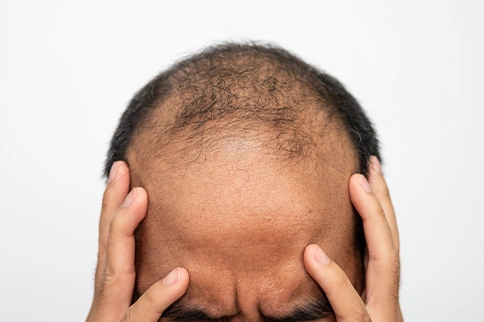
Hair loss after age 40 is normal and affects both men and women. It's a gradual process caused by natural hormone changes, genetics, and your hair's growth cycle slowing down with age. But that does not mean you should ignore it. In most cases, gradual, symmetric thinning that runs in families is age-related, but sudden shedding, patchy bald spots, or scalp irritation can indicate an underlying problem. In this blog, you will learn what's typical for men over 40, what needs to be addressed more closely, and what treatment options may help.
Causes of Hair Loss in Men Over 40
There are many reasons for hair loss in men over 40; however, it can occur due to factors such as genetics and the male hormone DHT. As hair follicles become sensitive to DHT over time, they shrink and produce fine, short hair until they stop growing altogether. A combination of lifestyle and biological factors can trigger or increase hair thinning. Some of the key factors include:
- Androgenetic Alopecia (Male Pattern Baldness): This is the most common cause, where you will notice a receding hairline at the temples along with thinning at the crown.
- Hormonal shifts: Hair follicles that are genetically sensitive to DHT continue to undergo miniaturisation over time, even as overall testosterone levels gradually decline.
- Medical conditions: Medical conditions such as thyroid disorders, diabetes, autoimmune diseases (including lupus), and nutritional deficiencies can contribute to hair loss.
- Side-effects of medication: Men over 40 start taking daily prescriptions for underlying health conditions. Cholesterol drugs, blood pressure medications and antidepressants cause hair thinning as a side effect.
- Nutritional deficiencies: A diet that lacks protein, iron and vital nutrients will disturb the hair growth cycles. This leads to weaker hair shafts and increased shedding.
- Chronic stress: High stress levels can force the hair roots into a premature resting phase, which results in sudden and temporary hair shedding.
Risk Factors for Hair Loss in Men Over 40
As men reach 40, half of them experience visible hair thinning. The primary types of hair loss in this age group include androgenetic alopecia (male pattern baldness), telogen effluvium (stress-induced shedding), alopecia areata (patchy autoimmune loss) and medical or lifestyle-related diffuse thinning.
- Genetics and Hormones
- Family history: Balding tends to run in families.
- DHT Levels: Hormonal changes with age can shrink the hair follicles over time.
- Health & Lifestyle
- Chronic stress: High levels of both physical and emotional stress can trigger sudden hair shedding.
- Nutritional gaps: Deficiencies in key nutrients such as iron, protein and key vitamins weaken the hair growth cycle
- Medical conditions: Scalp Infections, thyroid imbalances, and autoimmune conditions can cause thinning or bald patches
- Lifestyle adjustments that support hair health
- Lifestyle Care: Balanced diet, gentle hair-washing habits, and stress reduction support overall scalp health.
Types of Hair Loss in Men Over 40
As men reach 40, half of all of them experience visible hair thinning. The primary types of hair loss in this age group include androgenetic alopecia (male pattern baldness), telogen effluvium (stress-induced shedding), alopecia areata (patchy autoimmune loss) and medical or lifestyle-related diffuse thinning.
- Telogen Effluvium
This is a temporary disruption in the hair growth cycle that pushes a large number of follicles into the resting phase. It typically presents as sudden, diffuse shedding, with a handful of hairs coming out in the shower or when brushing. It is caused by factors such as major illnesses, severe physical and emotional stress, rapid weight fluctuation and thyroid imbalance. - Androgenetic Alopecia (Male Pattern Baldness)
This is the most common genetic and hormone-driven cause of hair loss that affects up to 50% of men by age 40. It shows up as a receding hairline at the temples (forming an M- or U-shape) and progressive thinning at the crown. It is caused by sensitivity to dihydrotestosterone (DHT), a testosterone by-product that shrinks hair follicles over time. - Alopecia Areata
This is an autoimmune condition in which the body's immune system mistakenly attacks healthy hair follicles. They show up as smooth, round or oval patchy bald spots on the scalp or face. It is caused by immune system dysfunction triggered by genetic and environmental factors. - Systemic and Medical Hair Thinning
This type of hair loss is secondary to underlying systemic health shifts common in midlife. It shows up as overall thinning or brittle strands that lack their usual density. It is caused by chronic conditions, including blood pressure medications, diabetes, nutritional deficiencies (such as low iron or Vitamin D), or hormonal shifts.
Ageing and Hair Loss: How Your Hair Changes With Age
Ageing is a natural process and naturally alters your hair's life cycle, structure, and pigmentation. As the follicles shrink, hair strands become finer, growth slows, and volume decreases. With ageing, both men and women experience a decline in their hair density. The duration of the anagen (growth) phase gradually shortens with age, leading to finer terminal hairs.
Hair may turn grey or white when the pigment-producing melanocytes at the base of the hair follicle reduce or stop producing melanin. The scalp also produces less natural oil, depriving the hair shaft of its protective barrier. This makes the hair rough, dull, and more prone to breakage. It also leads to fragility and hair thinning. True baldness (such as male or female pattern alopecia) is mainly caused by inherited genes and hormonal changes, which can accelerate hair loss with age.
Understanding the Hair Growth Cycle
The human hair growth cycle is a continuous, repeating process in which each hair follicle goes through four distinct stages. At any given point in time, your scalp has hairs in all different phases.
| Phase | What Happens | Duration | Key Facts |
|---|---|---|---|
| Anagen (Growth Phase) | Active cell division creates the hair shaft | 2 to 7 years | Makes up 85-90% of your hair; determines how long it can grow. |
| Catagen (Transition Phase) | Growth stops, and the follicle shrinks. Hair detaches from its blood supply. | About 2 weeks | Marks the shift from active growth to rest |
| Telogen (Resting Phase) | The follicle rests while the new hair starts forming underneath | About 3 months | Accounts for roughly 10-15% of hair |
| Exogen (Resting Phase) | The old hair strand falls out. The follicle returns to the anagen phase | Ongoing | Normal shedding is 50 to 100 hairs per day |
Hair Thinning Vs Balding in Men over 40: What's the Difference?
Hair thinning and balding are different concepts. Thinning means hair loses its density while still growing, and balding means complete hair loss in specific areas. Let's understand the difference here.
| Aspect | Hair Thinning | Balding (Male Pattern Baldness) |
|---|---|---|
| Definition | Individual hairs become finer and scalp coverage decreases gently | Hormones (DHT) shrink follicles until they stop producing hair |
| Distribution | Spreads evenly across the scalp (diffuse) or follows normal ageing | Follows a set pattern- receding hairline or crown bald spot ("M" or "U" shape) |
| Reversibility | Often improves if linked to nutrition, stress, or health triggers | Permanent without targeted medical care |
Signs Your Hair Loss After 40 Needs Medical Attention
Hair growth slows down and individual strands thin after age 40, and sudden changes can indicate health problems. Hair loss accompanied by redness, scalp pain, or rapid shedding should be discussed with a medical professional. Watch out for these warning signs:
- Rapid shedding and clumping: Most people naturally shed around 50-100 per day. But seeing handfuls of hair come out in the shower, on the pillow, or when brushing can indicate a systemic issue, such as a thyroid imbalance or a reaction to a major stressor, known as telogen effluvium.
- Patchy hair loss: Abruptly appearing or circular bald spots suggest alopecia areata, an autoimmune disorder where the immune system attacks the hair follicles.
- Thinning or loss in other areas: Noticeable thinning in your eyelashes, eyebrows or beard alongside scalp loss can indicate autoimmune or severe nutritional deficiencies.
- Receding hairline or vertex thinning: The gradual receding of the hairline or thinning of the crown can indicate male pattern baldness, a hereditary condition. If scalp irritation is present, other underlying causes should be considered.
- Physical symptoms: Hair loss accompanied by cold intolerance, fatigue, brittle nails, and unexplained weight changes may indicate conditions like thyroid disease or anemia.
How Is Hair Loss Diagnosed?
Diagnosing hair loss goes beyond a glance at the scalp. It involves understanding your lifestyle, medical history, and the condition of your hair follicles in greater depth. Here's how the process works
- Comprehensive assessment
The consultation goes beyond surface symptoms. A detailed 40-45 minute evaluation wherein a person's family and medical history, lifestyle factors, stress levels and dietary habits are taken into consideration to identify the precise cause of your hair fall. This is the first step that lays the foundation for understanding your unique situation. - Advanced Diagnostic Analysis
Using AI hair analysis technology, the hair doctor assesses 50+ parameters, including scalp condition, hair density, follicle health, growth-phase distribution, and hair shaft thickness. The insights gathered from this assessment help our expert hair doctors craft a personalised treatment plan specific to your hair condition. - Customised Treatment Design
Based on the doctor's assessment and insights from AI hair analysis, our doctors design a treatment plan that combines homeopathy with advanced hair-aesthetics treatments to ensure faster, long-lasting results. Once treatment commences, our team ensures your treatment progresses and that outcomes are tracked regularly. - Continuous Monitoring & Adjustment
Treatment progress is regularly tracked through an outcome report. This outcome report helps patients transparently track their treatment progress and helps doctors take necessary action in the treatment approach, if required.
Lifestyle and Health Factors That Speed Up Hair Loss in Men Over 40
Lifestyle factors can worsen inflammation, oxidative stress, and overall follicular health, potentially accelerating genetically predisposed hair loss. The key factors are:
- Chronic stress: Long-term stress increases androgen and cortisol levels, which can shock the hair follicles into an early resting phase. This causes the hair to shed in large quantities.
- Crash diet and poor nutrition: Restrictive diets lead to nutritional deficiencies, especially in zinc, iron and protein. Without these building blocks, the hair growth cycle is stunted, thinning hair and leading to brittleness.
- Alcohol and smoking: Smoking restricts the blood vessels, thereby reducing the essential oxygen and nutrient flow to the hair follicles. Meanwhile, drinking too much alcohol dehydrates the body and drains zinc and B vitamins, which your hair needs to stay healthy.
- Metabolic issues and sedentary lifestyle: A sedentary lifestyle can contribute to insulin resistance and metabolic dysfunction, both of which have been associated with increased hair loss risk. Regular physical activity helps improve metabolic health.
5. Medications: Common drugs prescribed to men over 40, including medications for high blood pressure, anxiety and cholesterol, list hair thinning as a side effect. - Scalp damage (Traction alopecia): Overuse of harsh chemicals, pulling hair too tightly into buns and ponytails, and high-heat styling tools can permanently damage hair follicles.
How to Slow Down Hair Thinning in Men Over 40: Daily Habits
Men over 40 looking to slow hair thinning should focus on a core daily routine. Here's how:
- Scalp massage: Scalp massage may improve scalp comfort and has shown benefits in increasing hair thickness in small studies, although stronger evidence is still needed
- Add more lean protein to your diet: Since hair is made of the protein keratin, a lack of it can weaken brittle strands. Hence, one should focus on eggs, lean meats, fish, beans and lentils.
- Check for key vitamins: Deficiencies in these nutrients have been associated with increased hair shedding in some individuals.
- Consume anti-inflammatory foods: Consume antioxidant-rich foods, omega-3 fatty acids and leafy greens to promote a healthy scalp environment.
- Avoid pulling hairstyles: Avoid tight ponytails, caps and buns that pull at the hairline and cause traction alopecia.
- Change the shampoo: Choose a mild shampoo suited to your scalp type. If your scalp feels dry or sensitive, a sulfate-free shampoo may be helpful.
- Stop smoking: Smoking restricts the blood vessels, impeding the flow of oxygen and key nutrients directly to your hair follicles.
- Ensure 7-8 hours of sleep: Adequate sleep supports hormonal balance and normal tissue repair, both of which are important for overall hair health.
Best Treatment for Male Hair Loss: Options Worth Considering
Hair loss after 40 does not have to mean settling for it. Dr Batra's® offers a range of advanced and non-surgical treatments personalised to different stages and causes of hair loss. The right treatment depends on the extent and cause of your hair loss, so it's important to get a proper scalp assessment before choosing one. Below are the hair growth treatments offered at Dr Batra's®.
Hair Gain
India's first hair regrowth treatment with 50 billion exosomes, powered by the TriXo Complex, a blend of exosomes, caffeine & collagen, and polypeptides that work at the scalp's biological level to stimulate regeneration and repair.
- Targets the root cause of hair loss
- Visible results in 75 days
- Free from side-effects
- Effective for all types of hair loss
- No surgery, no injections & no pain
Dr Batra's® XOGEN Advance
A non-surgical hair regrowth treatment powered by 10 billion nano-sized exosomes, scientifically formulated to repair hair follicles, promote new hair growth, and restore thinning hair quickly, safely, and effectively.
- Repairs follicles & stimulates new hair growth
- Treats hereditary & other types of hair loss
- Safe, needle-free & pain-free treatment
- Visible results reported in just 6-8 sessions
STM (Scalp Treatment Modality)
An advanced and non-surgical treatment that utilises plant stem cell extracts and French technology to stimulate hair follicles, minimise thinning, and improve scalp circulation.
- Minimises hair thinning
- Enhances cellular multiplication
- Improves blood circulation in the scalp
- Reports an 88% success rate
groHair™ - Comprehensive Hair Wellness Program
A non-surgical, French technology-based treatment that uses electroporation and a nutrient-rich serum (amino acids and multivitamins) to penetrate the scalp and reactivate dormant follicles.
- Boosts regrowth, volume & overall scalp health
- 77% success rate
- Visible results in 8-10 sessions (about 10 weeks)
Can Homeopathy Help With Balding in Men Over 40?
Homeopathy takes a whole-body approach to balding and focuses on underlying causes, including stress, hormonal imbalances and nutritional deficiencies, rather than just visible hair loss. Through individualised and constitutional remedies, it aims to stimulate the body's natural healing response, slow hair fall, help revive dormant follicles and improve overall scalp health.
Expert Care at Dr Batra's®
At Dr Batra's®, we understand that hair loss in men over 40 isn't the same for everyone. While some experience hair fall due to stress or nutritional deficiencies, others may be affected by hormonal changes, genetics, or underlying scalp conditions. That's why our approach focuses on identifying the root cause before recommending a personalised treatment plan.
Our comprehensive approach includes:
- Detailed hair and scalp assessment
- AI-powered hair diagnostics
- Personalised homeopathic treatment
- Lifestyle and nutritional guidance
- Long-term support focused on complete hair and scalp health.
With 35+ years of clinical expertise and 1.5 million+ happy patients globally, Dr Batra's® combines personalised homeopathic care with advanced diagnostic technology to help men manage hair thinning and balding holistically, at every stage of life.
Frequently Asked Questions
- Causes of Hair Loss in Men Over 40
- Risk Factors for Hair Loss in Men Over 40
- Types of Hair Loss in Men Over 40
- Ageing and Hair Loss: How Your Hair Changes With Age
- Understanding the Hair Growth Cycle
- Hair Thinning Vs Balding in Men over 40: What's the Difference?
- Signs Your Hair Loss After 40 Needs Medical Attention
- How Is Hair Loss Diagnosed?
- Lifestyle and Health Factors That Speed Up Hair Loss in Men Over 40
- How to Slow Down Hair Thinning in Men Over 40: Daily Habits
- Best Treatment for Male Hair Loss: Options Worth Considering
- Can Homeopathy Help With Balding in Men Over 40?


Get Your Personalised Health Treatment Today


Working hours: 10am to 9pm daily.
Have Enquiries?
Leave your details and our hair therapy specialist will respond to your query shortly.