Guttate Psoriasis: The Lesser-Known Type Triggered by Infections
Talk to Our Experts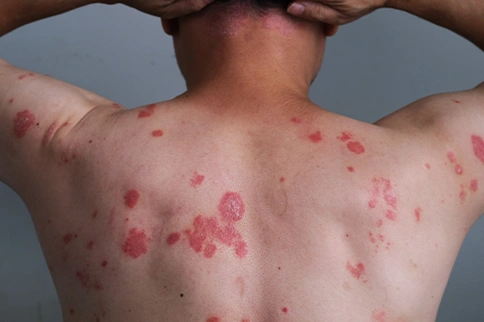

- 25+ Years of experience
- Hair Specialist,
- Skin Specialist
"You got over a sore throat a couple of weeks ago - so why is your skin suddenly covered in tiny red spots?"
It shows up overnight - a scatter of small, drop-shaped pink spots across your chest, back, and arms that weren't there yesterday. Same soap, same routine, nothing new touched. So you blame a detergent, an allergy, the weather. But the real clue isn't on your skin at all.
It's in a sore throat you had a couple of weeks ago and had already forgotten. That's the odd, easily-missed signature of guttate psoriasis - and here's what it actually is, why an infection sets it off, and what genuinely helps.
What Is Guttate Psoriasis? Understanding This Lesser-Known Type
The name gives away its appearance. "Guttate" comes from the Latin gutta, meaning a drop - and that's exactly what this type of psoriasis resembles: small, drop-shaped spots scattered across the skin, as though someone flicked paint from a brush.
So, what is guttate psoriasis? Like all psoriasis, it's immune-driven - the immune system misreads a signal and dramatically speeds up skin renewal, so cells that should take weeks to surface, pile up in days. That's what you see and feel as scaly spots. What sets the guttate form apart is the shape (small and drop-like, not large patches), the spread (many spots at once across the trunk and limbs), and the timing (it often follows an infection).
One thing to clear up straight away: this isn't poor hygiene, and it isn't something you caught from anyone. It's your own immune system overreacting to a trigger. You did nothing wrong, and there's nothing to be embarrassed about.
What Causes Guttate Psoriasis? The Infection Connection
This is where the guttate form earns its "infection-triggered" name. The best-recognised trigger by far is a streptococcal infection - usually strep throat, sometimes tonsillitis. The spots classically appear one to three weeks later, which is exactly why the two rarely get connected.
The mechanism, in plain terms: the infection revs up your immune system to fight it off, and in someone predisposed, that heightened activity spills over onto the skin. Your body is reacting to the aftershock of the infection - not to anything on the skin itself.
Strep is the headline trigger, but it isn't the only one. Other contributors that can set off or worsen a flare include:
- Other viral or bacterial infections, including upper-respiratory ones
- Significant physical or emotional stress
- Injury to the skin, such as a cut, burn, or bad sunburn
- Certain medications
- Cold, dry weather that leaves skin more reactive
For most people, it's a specific trigger landing on an underlying susceptibility - not one villain, but the wrong combination at the wrong time. Knowing your own triggers points straight at what to manage to avoid a repeat. Not sure what set off your flare? Our doctors take a detailed look at your infection history, stress and lifestyle to pinpoint your personal triggers. Get you skin Checked
Common Guttate Psoriasis Symptoms to Watch Out For
Guttate psoriasis symptoms tend to be fairly recognisable once you know what to look for. The most common ones:
- Small, drop-shaped spots - usually a few millimetres across, pink to red or salmon-coloured
- Fine scaling on top of the spots, lighter than the thick silvery scale of plaque psoriasis
- A widespread scatter - often dozens to hundreds of spots appearing over a short period
- Typical locations - the trunk (chest, back, tummy) most of all, plus the arms, legs, and sometimes the scalp, ears, and face
- Mild itching or irritation, though for some people the spots aren't especially itchy
- A recent infection, particularly a sore throat, in the preceding couple of weeks
On darker skin tones, the spots can look more violet, brown, or grey than red - worth knowing, as it can delay people seeking advice. One or two odd marks are just skin being skin; a sudden, widespread crop of drop-shaped spots, especially after a sore throat, is the pattern to act on.Does this sound like what’s on your skin? A quick consultation can confirm whether it’s guttate psoriasis or something that only looks similar. Get Your Skin Evaluated
How to Identify a Guttate Psoriasis Flare-Up
A guttate psoriasis flare-up has a fairly characteristic rhythm, and recognising it helps you act sooner rather than second-guessing for weeks. The tell-tale signs of a flare:
- The onset is sudden - spots appear over days, not gradually over months
- They arrive in numbers and spread, rather than staying as one or two isolated marks
- There's often a recent trigger you can trace back to, most commonly a sore throat or other infection
- The spots are uniform in that drop-like shape, rather than the large plaques of other types
- Existing spots may become more red, raised, or itchy as the flare builds
Think of a flare as having a beginning, a peak, and a settling phase. Many calm down over a few weeks to months, especially once you treat any underlying infection. But "it'll probably settle" isn't the same as "ignore it" - an early look means you know what you're dealing with and can ease the discomfort meanwhile. And if the same pattern keeps following infections, flag it to a doctor.
Is Guttate Psoriasis Contagious or Hereditary?
Two of the most common worries, so let's take them one at a time - and clearly.
Is it contagious? No. Worth saying plainly, because a spread of spots can look alarming and cause unnecessary awkwardness. Guttate psoriasis isn't a skin infection and can't be passed on - not by touch, a shared towel, or a swimming pool. You can't catch it, and you can't give it. (The strep throat that triggered it can spread, but that's the throat infection, not the psoriasis.)
Is it hereditary? Partly. Psoriasis does run in families, and a close relative with it raises your odds of some form. But genetics load the dice rather than decide the outcome - many with a family history never develop it, and many with guttate psoriasis have none at all. Think of it as inheriting a susceptibility that a trigger, like an infection, then switches on.
Who Is at Higher Risk
Guttate psoriasis can affect anyone, but a few factors increase your risk. You may be at higher risk if you:
- Are a child, teenager, or young adult - this form skews younger than most types of psoriasis
- Have a family history of psoriasis of any kind
- Have recently had a streptococcal or other infection, especially a throat infection
- Have already had guttate psoriasis before, as recurrences after infections are common
- Are under a stretch of significant stress, which can lower the threshold for a flare
- Have a weakened or highly active immune system for other reasons
Being in one or more of these groups doesn't mean a flare is coming-it simply means it's worth being a little more alert to early signs and quicker to treat throat infections properly when they crop up. Seeing sudden spots on your child after a sore throat? Our doctors offer gentle, child-friendly care. Book an assessment to know exactly what you’re dealing with.
How Is Guttate Psoriasis Diagnosed?
The good news: guttate psoriasis is usually straightforward to identify once you know the pattern. The diagnosis typically involves:
- A physical examination - the distinctive drop-shaped spots and their spread are often enough to recognise it.
- A look at your recent history - recent sore throat or infection, stress, new medications, family history. That timeline is often the clincher.
- A throat swab or blood test - to check for streptococcal infection, since confirming and treating strep can be part of settling the flare.
- A skin biopsy - occasionally, if the diagnosis isn't clear or another condition needs ruling out.
Why bother with a proper diagnosis rather than self-labelling? Several skin conditions produce similar-looking spots - and the right treatment follows from the right diagnosis.
When Should You Consult a Doctor for Guttate Psoriasis?
A mild, short-lived crop of spots that settles quickly may not need much—but there are clear situations where it's genuinely worth getting advice rather than waiting it out. See a doctor if:
- The spots are spreading, widespread, or not settling over a couple of weeks
- They're itchy, uncomfortable, or affecting your sleep or confidence
- You had a recent sore throat or infection and want the strep link checked and treated
- Flares keep recurring, particularly after infections
- You're unsure what the spots are and want a proper diagnosis
- The condition is taking a toll on your mood or self-esteem—the emotional side of a visible skin condition is real and deserves support too
And a word on the bigger picture: living with a visible skin condition can quietly wear on your confidence and mood over time. That's a valid reason to seek help in its own right. If low mood ever deepens into hopelessness, or you have any thoughts of harming yourself, please treat it as urgent—reach out to a doctor, a mental health professional, or a helpline straight away, and tell someone you trust. You don't have to carry that alone.
How to Treat Guttate Psoriasis: What Works Best?
There's no single switch that turns it off, but plenty genuinely helps—and treating guttate psoriasis sensibly makes flares shorter and easier to live with. Treatment is tailored to how widespread and bothersome the spots are, usually pairing medical care with everyday self-care.
Common medical approaches include:
- Topical treatments - creams and ointments applied to the skin, such as corticosteroids, vitamin D-based preparations, and moisturisers to ease scaling and irritation.
- Phototherapy - controlled exposure to specific ultraviolet light under medical supervision, which can help when spots are widespread. (This is not the same as unprotected sun exposure or tanning beds, which can do more harm than good.)
- Treating the underlying infection - if a streptococcal infection is found, addressing it is part of settling the flare.
- Systemic treatments - reserved for more severe or persistent cases, and always under specialist guidance.
Self-care and lifestyle measures that support any treatment plan:
- Moisturise regularly to keep skin supple and reduce scaling and itch
- Be gentle with your skin — avoid scratching, harsh scrubbing, and irritating products
- Protect against skin injury, since cuts, burns, and bad sunburn can trigger fresh spots
- Manage stress in whatever way genuinely works for you, as stress is a known aggravator
- Treat throat infections promptly rather than letting them run
- Avoid smoking and limit alcohol, both of which can worsen psoriasis for many people
A quick, honest caveat: what works best varies from person to person, and severe or stubborn cases are best guided by a professional rather than managed by trial and error at home.
How Does Homeopathy Help in Managing Guttate Psoriasis?
Homeopathy takes a whole-person view, which suits this condition well - because so much of what drives a flare (infection susceptibility, stress, an overactive immune response) sits beneath the skin, not on it. Rather than treating only the visible spots, the approach looks wider: your infection history and how easily you pick things up, your stress and sleep, your family history, and how your skin behaves over time. The aim is to support the body's own regulation and ease the tendency to flare - not just quieten today's crop of spots.
To be straightforward: homeopathy is best seen as part of a considered, root-cause approach that takes your triggers seriously and generally comes with fewer side effects - not an overnight cure. For severe, fast-spreading, or persistent cases, it belongs within a broader, professionally guided plan, alongside timely treatment of any underlying infection. The right path is the one built around you after a proper assessment.
Expert Care at Dr Batra's®
At Dr Batra's®, we see guttate psoriasis for what it really is — not a skin problem in isolation, but an immune system reacting to a trigger in a person with their own history, stresses, and susceptibilities. So we don't just hand over a cream and send you on your way. We look at the whole picture and the person living in it.
Our approach includes:
- A detailed case history covering your recent infections, stress, lifestyle, family history, and how your skin behaves over time
- Personalised homeopathic treatment aimed at the root tendency to flare, not only the spots you can see today
- Ongoing monitoring, so your plan is adjusted as your skin genuinely responds
- Compassionate, judgement-free, confidential care that takes the emotional weight of a visible skin condition seriously
To be honest, managing guttate psoriasis well is as much about understanding and easing your triggers as it is about what you apply to the surface, and severe or persistent cases are best supported as part of a broader, professionally guided plan. What we offer is a personalised, whole-person approach - and with decades of clinical experience and patients treated across the globe, Dr Batra® pairs science-backed homeopathic care with the human understanding a condition like this so often needs.
Conclusion
A sudden scatter of small, drop-shaped spots - especially in the weeks after a sore throat - isn't a stray allergy or a reaction to your soap. More often than not, it's guttate psoriasis: your immune system reacting to a trigger and showing it on your skin. It isn't contagious, it isn't your fault, and it isn't a life sentence. Many flares settle with the right care once you address any underlying infection, and knowing your triggers goes a long way toward heading off the next one.
So if your skin has thrown up spots you can't account for, don't wait and wonder. Reach out to the team at Dr Batra's® for a proper, personalised, judgement-free assessment - and get clear answers about what's going on and what genuinely helps.
Frequently Asked Questions
- What Is Guttate Psoriasis? Understanding This Lesser-Known Type
- What Causes Guttate Psoriasis? The Infection Connection
- Common Guttate Psoriasis Symptoms to Watch Out For
- How to Identify a Guttate Psoriasis Flare-Up
- Is Guttate Psoriasis Contagious or Hereditary?
- Who Is at Higher Risk
- How Is Guttate Psoriasis Diagnosed?
- When Should You Consult a Doctor for Guttate Psoriasis?
- How to Treat Guttate Psoriasis: What Works Best?
- How Does Homeopathy Help in Managing Guttate Psoriasis?
- Expert Care at Dr Batra's®


Get Your Personalised Health Treatment Today


Working hours: 10am to 9pm daily.
Have Enquiries?
Leave your details and our hair therapy specialist will respond to your query shortly.