
- 20+ Years of experience
- Dermatology,
- Hair Specialist,
- Skin Specialist
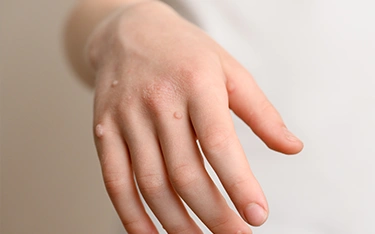
Warts are non-cancerous skin growths caused by the human papillomavirus (HPV). They can appear as bumps or rough growths in different parts of the body and may be skin-colored, dark, smooth, or spiky. Warts are contagious and can be painful or asymptomatic, depending on their type and location.
Common Types of Warts
Common Warts (Verruca Vulgaris)
- Appear as rough, grainy bumps
- Can be grey, flesh-colored, or have a cauliflower-like texture
- Usually found on the hands, fingers, and around nails
- May have black dots due to clotted blood vessels
- Spread through direct skin contact or contaminated surfaces
Plantar Warts
- Occur on the soles of feet, making walking painful
- Grow inward due to pressure, causing discomfort
- Two types:
- Myrmecial-type: Deep, calloused, and tender to touch
- Mosaic-type: Clustered warts that grow on the surface and are less painful
- Risk factors include walking barefoot in public areas like pools and locker rooms
Flat Warts
- Small, smooth, slightly raised warts
- Commonly found on the face, arms, and thighs
- Typically occur in clusters of 20 to 200 warts
- Spread easily through shaving or broken skin
Filiform Warts
- Long, thread-like warts that grow on the face, neck, eyelids, or lips
- Highly contagious and can spread quickly
- Often mistaken for skin tags
- Can cause itching or irritation if accidentally scratched
Genital Warts
- Caused by sexually transmitted HPV infection
- Appear on the genitals, inner thighs, anus, or oral mucosa
- May be small, flesh-colored bumps or clusters resembling cauliflower
- Can lead to cervical and other cancers, requiring immediate medical attention
Periungual Warts
- Occur around fingernails and toenails
- Begin as tiny growths and can spread under the nail, causing discomfort
- More common in individuals who bite their nails
- Can distort nail shape and increase infection risk
Dr Batra’s® pro tip:
Good hygiene is key to preventing warts. Always wear footwear in public showers or pools and avoid sharing towels, razors, or socks with others
Causes and Risk Factors
General Causes
- HPV infection – The primary cause of all wart types
- Direct contact with infected skin or surfaces
Specific Risk Factors
- Plantar Warts: Infection through cuts on feet, walking barefoot in public spaces
- Flat Warts: More common in children and young adults
- Filiform Warts: Spread through shaving or direct skin contact
- Genital Warts: Unprotected sexual contact, multiple partners
- Periungual Warts: Nail-biting and damaged skin around nails
Available Medical Treatments
Cryotherapy (Freezing)
- Liquid nitrogen is applied to freeze and destroy wart tissue
Electrosurgery and Curettage
- Warts are burned off using an electric current or scraped away
Laser Treatment
- High-intensity laser beams are used to eliminate wart tissue
Homeopathic Treatments for Warts
Homeopathy offers a natural, side-effect-free approach to treating warts by boosting the immune system to fight the HPV virus.
Effective Homeopathic Remedies
- Thuja Occidentalis: For brownish, easily bleeding warts
- Causticum: For moist, yellowish warts
- Antimonium Crudum: For smooth warts that ulcerate
- Dulcamara: For crusted warts that itch or burn
- Nitric Acidum: For sensitive warts that bleed upon touch
- Natrum Mur: For hard, dry warts
Homeopathy treats warts safely and painlessly, unlike conventional removal methods, which may cause scarring or recurrence.
When to Consult a Healthcare Professional
While some warts may disappear on their own, medical consultation is necessary if:
- Warts cause pain or discomfort
- There is rapid spread of warts
- The warts bleed, change color, or become infected
- Genital warts are present
Dr Batra’s® homeopathic specialists provide customized wart treatments with holistic, safe, and effective solutions.
Choose natural, side-effect-free wart removal with Dr Batra’s®
Book an AppointmentConclusion
- Warts are persistent and contagious, often requiring timely intervention.
- With the right treatment, they can be effectively managed and prevented from spreading
Sources
Frequently Asked Questions
- Avoid direct contact with infected skin or surfaces
- Keep skin moisturized to prevent cuts and cracks
- Practice good hygiene and avoid sharing personal items
- Wear protective footwear in public showers or pools


More in Hair
Trending Now
How to Reduce Acne Scars Naturally and Effectively
Best shampoos for scalp psoriasis
10 most common skin disorders
Get Your Personalised Health Treatment Today


Working hours: 10am to 9pm daily.
Have Enquiries?
Leave your details and our hair therapy specialist will respond to your query shortly.