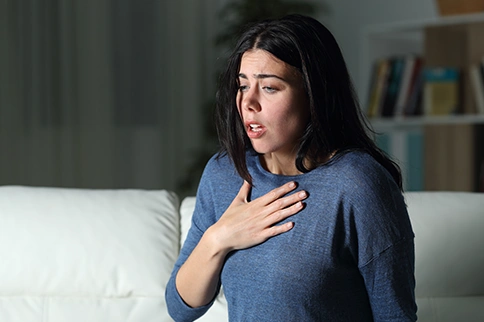
"Your chest feels tight. Your heart's racing. Your hands have gone cold, and somewhere in the middle of all that, a genuinely terrifying thought shows up - is this a heart attack?"
You sit very still. You count your breaths. You wait.
Ten minutes later, it's gone. No ER visit. No diagnosis. Just... gone, the way it came.
Did it sound familiar?
Here's what makes this so confusing - this wasn't "in your head." Your chest actually hurt. Your heart actually raced. It was real. It just wasn't a heart problem.
It was anxiety. And yes, anxiety can genuinely do this to your body.
Most people think of anxiety as a mental thing - overthinking, worry, that sort of thing. What they don't expect is for it to show up as an actual physical event. Chest pain. Dizziness. Nausea. Symptoms that feel urgent enough to send you searching your symptoms online at 1 a.m.
So let's actually get into it - why this happens, how to tell it apart from something more serious, and when "it's probably just anxiety" stops being a good enough answer.
What Is Anxiety, Really?
Anxiety gets lumped in with "stress" a lot. Also with overthinking. But none of that is quite right.
At its core, anxiety is your body's alarm system. A useful one, most of the time - it's the reason you double-check the stove is off, or get a little sharper before an important meeting. The trouble starts when the alarm doesn't know when to stop.
When it becomes chronic, it stays on even when there's genuinely nothing wrong. And an alarm that won't switch off doesn't just sit quietly in your head - it pulls in your heart rate, your breathing, your digestion, your muscles. Basically, everything.
That's the bit people miss. Anxiety isn't a thought problem living politely inside your skull. It runs through the whole body.
Can Anxiety Cause Chest Pain?
Yes, anxiety can definitely cause chest pain. More often than you would think, actually.
When anxiety spikes, your body dumps stress hormones like adrenaline and cortisol into your system - the same chemicals behind fight-or-flight. Your heart rate climbs. Breathing goes shallow and fast. The muscles around your ribs and chest tighten up. Blood moves away from digestion and toward your limbs, because apparently your body still thinks you might need to sprint from something.
Put all of that together, and you get tightness, heaviness, sometimes a sharp jab in the chest - close enough to a cardiac symptom that it's genuinely alarming.
Which is exactly why "can anxiety cause chest pain" gets searched so often, usually mid-panic, phone in hand and your heart still racing. And the fear itself becomes fuel - chest pain makes you scared of a heart problem, which makes you more anxious, which tightens the chest even more. Nasty little loop.
Anxiety Chest Pain vs Heart Attack: How to Tell the Difference
This is the part that actually matters, so let's not rush it. Get this wrong either way, and it's a problem - ignoring a real cardiac event is dangerous, but panicking every time your chest feels off isn't great either.
A few patterns that tend to hold (not a diagnosis, just a starting point):
Anxiety-related chest pain is usually sharp or localised, and it tends to fade within 10 to 20 minutes as the anxiety settles down. It also rarely shows up alone - racing thoughts, a sense of dread, tingling hands; that whole cluster tends to come with it.
Heart attack pain behaves differently. It's more often described as crushing, like something's sitting on your chest, and it tends to spread to the arm, the jaw, sometimes the back. It usually doesn't ease up just because you are breathing slower. Cold sweats and nausea that worsen with exertion are also more typical of a cardiac event than of an anxious one.
Honestly, if you are ever unsure, don't try to figure it out on the spot. Treat it like an emergency first, ask questions later. This blog isn't the thing that should be making that call for you. Once anxiety's actually confirmed as the cause, that's when it's worth digging into the root of it.
Other Physical Symptoms of Anxiety
Chest pain gets most of the spotlight, but it's rarely travelling alone. A few others that show up more than people realise:
- Dizziness or that lightheaded feeling - usually from breathing too fast and shallow, which messes with your blood oxygen levels
- Nausea, or just a generally unsettled stomach - the gut is wired directly into the nervous system, so anxiety hits digestion almost immediately
- Shortness of breath - that odd sensation of not getting a full breath in, even though nothing's physically blocking it
- Tingling in the hands or feet - usually from hyperventilating without quite realising it
- Tight shoulders, jaw, neck - anxiety loves to sit in muscles
- Fatigue that doesn't line up with how much sleep you actually got
- A heart that's pounding even when you're just sitting there, doing nothing
Any one of these on its own is easy to brush off. All of them together, showing up again and again, start to tell a different story - one that's about the nervous system, not something structurally broken.
Why Does Anxiety Show Up in the Body at All?
Because the mind and body were never really separate to begin with. That's the short version.
The longer version: your brain and body are constantly talking to each other through the nervous system, and anxiety basically turns up the volume on that conversation. The brain thinks it senses a threat - real or not, doesn't matter - and tells the rest of the body to get ready. Heart rate goes up so you can run. Breathing speeds up for oxygen. Digestion gets deprioritised because who cares about lunch when you are "in danger."
Except in modern life, that danger is usually a deadline. Or a spiralling thought at 2 a.m. There's nothing to actually run from, so all that physical readiness has nowhere to go. It just sits there - in your chest, your stomach, your pulse.
Your body genuinely can't tell the difference between a tiger and a tense email. It reacts the same either way, which is honestly a little unfair to your nervous system.
When Physical Symptoms Signal It's Time for Anxiety Treatment
A racing heart before a big presentation? Normal. Nothing to overanalyse there.
It's worth paying more attention when:
- The physical symptoms start becoming frequent instead of occasional
- You have started avoiding certain situations just because they might trigger it
- Sleep, appetite, or focus at work start slipping
- You have already ruled out a medical cause and the symptoms keep showing up anyway
- The fear of the next episode becomes bigger than the episode itself
If a few of these sound familiar, this has probably moved past "occasional anxious moment" territory. That's usually the point where breathing exercises and hoping it passes stop being enough.
Expert Care at Dr Batra's®
At Dr Batra's®, this pattern isn't new to us. Physical symptoms of anxiety are real, and they deserve to be taken seriously - not brushed off as "it's probably nothing" once the scans come back clear.
So our approach doesn't stop at calming down whatever symptom walked through the door. It includes:
- Actually understanding your history, your triggers, your day-to-day life - not just the chest pain or the dizziness that brought you in
- Personalised homeopathic care aimed at what's actually causing the anxiety, not just quieting the symptom for a while
- Practical, everyday coping tools alongside the treatment itself
- Support that continues, without judgement, for as long as you need it
With decades of clinical experience and patients treated across the globe, Dr Batra's® blends personalised homeopathic care with a genuinely human approach to mental wellbeing. Because no two anxious bodies - or minds - work quite the same way.
Conclusion
If a cough stuck around for weeks, you would see a doctor without thinking twice. So why let a racing heart, a tight chest, or nausea that won’t quit slide for months, just because the cause happens to be anxiety instead of something visible on a scan?
Physical symptoms of anxiety aren’t imagined, and they are not something you are supposed to just live with. Once anything urgent’s been ruled out, they’re a signal worth listening to - not one worth silencing.
If this all sounds a little too familiar, don’t wait for it to get worse. Talk to the experts at Dr Batra’s® for a personalised assessment and take the first step toward a calmer mind and body. You can also look into the MindFit programme by Dr Batra’s - built for anyone who wants to take their mental health as seriously as they’d take anything else showing up in their body.
Frequently Asked Questions


Get Your Personalised Health Treatment Today


Working hours: 10am to 9pm daily.
Have Enquiries?
Leave your details and our hair therapy specialist will respond to your query shortly.